Welcome!

Welcome to the NAIP's English-language blog on IP-related news and topics for inventors, engineers, companies and patent professionals in Asia. As we get started, feel free to share your thoughts, comments or any suggestions, and check back often for the latest updates.

Bookmark this page! or Subscribe (RSS)

TIPO to Reduce Design Patent Annuities

by Anita Li, NAIP Editorial

On 1 July 2011, new patent annuities for Taiwan design patents will go into effect. The draft of the new fee structure was presented at a public hearing on 22 March in order to collect general opinions and feedback before submission to the Taiwan Executive Yuan to finalize the draft.

Goal: Increase Design Patent Applications
At the public hearing, Director General of TIPO Wang Mei-hua stated that, although the number of invention patent applications has steadily increased in recent years, the number of design patent applications has actually been gradually decreasing. Director Wang also put forth the question that, although the patent annuities for design patent were already significantly reduced on 1 January 1, 2010, is there still room for further reduction? Director Wang indicated that considering the high percentage of small to medium size businesses (SMB) that account for Taiwan’s industrial make-up, the stagnant growth in design patent applications may suggest that design patent fees may still be too high.

In order to facilitate the government’s goal in supporting the development of Taiwan’s cultural and creative industry, TIPO hopes to increase the number of design patent applications by adjusting design patent annuities. TIPO believes a reduction in design patent annuities may offer practical assistance to natural persons and small enterprises that are comparatively weak financially. Lower overall costs would help better the environment for SMB in Taiwan.

Furthermore, TIPO also pointed out that feedback from industry representatives, who said considering Taiwan’s economic scale, the overall costs of a Taiwan design patent is rather high in comparison with those of other countries. Therefore, TIPO conducted research into the total design patent costs in European countries, the US, Japan, Korea, China and Australia, when drafting the proposal.

Based on this research, TIPO proposed the following fee reductions:
Design patent annuities: NT$ 1,000 per year from the first to the third year; NT$ 2,000 per year from the fourth to sixth year, and NT$ 3,000 from the seventh year onward. Under the new fee structure, over a period of 10 years the total amount of patent annuities would be NT$ 21,000. If including the NT$ 3,000 application fee and NT$ 1,000 issue fee, the total charge is NT$ 25,000. In comparison with the existing fee schedule, total costs have been reduced by around 40.5%, or NT$ 17,000

Furthermore, under the new fee structure, applicants who are schools, natural persons or SMBs will receive additional patent annuities discounts from the first to sixth years. During the first to third year, they need only pay NT$ 200 patent annuities per year, a reduction of NT$ 800. During the fourth to sixth years, the fee will be reduced by NT$1,200 to only NT$ 800 per year. Over then 10 year lifetime of a design patent, total official fee costs, including the patent annuities, application fee and issue fee, would be NT$ 19,000. In comparison to the existing fee schedule, the reduction is around 54.8%, or NT$ 23,000.

TIPO Design Patent Fee Structure


Existing Patent Fees

New, Proposed Fees

Fees for Qualified Schools, Natural Persons, SMBs

1st ~ 3rd Year

2,500

1,000

200

4th ~ 6th Year

3,500

2,000

800

7th Year Onward

5,000

3,000

3,000

Total Patent Annuities

38,000

21,000

15,000

Application Fee & Issue Fee

4,000

4,000

4,000

Total

42,000

25,000

19,000

Fee Reduction

/

17,000

23,000

Reduction Rate

/

40.5%

54.8%

Source: TIPO Public Hearing
Note: Effective on 1 July 2011
Units: NTD


Read more...

Patent firm North America Intellectual Property (NAIP) has received notice from the Taiwan Intellectual Property Office (TIPO) for issue of its 10,000th patent granted. Patent number M398638, for a display device, was filed on behalf of client Chunghwa Picture Tubes and published on February 21st, 2011.

"10,000 patents granted is truly impressive," says NAIP Patent Engineer Manager and Taiwan Patent Attorney Frank Wu. “Unlike other Taiwan firms that mainly translate existing foreign patent applications or focus on design and utility model patents, over 75% of our work is in the complete drafting, filing and prosecuting of high tech invention patents. We are really helping Taiwan companies turn their ideas into patents.”

As of March 21st, TIPO's online patent search system shows 10,064 patents granted with NAIP as the patent agent firm of record. Of this number, 9,539 are invention, 450 are utility model, and 75 design patents.

"Last year, NAIP reached over 10,000 United States patent applications filed, making us the largest US patent filing firm in Taiwan by volume," NAIP Patent Engineering Management Supervisor Almon Chen. "This 10,000 Taiwan patent grants milestone just proves again the depth of our experience and expertise in high tech patents."

With clients including 9 of the 10 Taiwan companies listed in BusinessWeek's Infotech 100, NAIP is renowned in the Taiwan IP industry as a high tech patent specialist with focus on Circuits, Telecommunication, Software, Image Processing, Semiconductor Materials, Memory Manufacturing, Measurement, Opto-electronics, Solar Energy, Chemical Engineering, Mechanical Structures and Data Storage Devices.

Read more...

Taiwan Patent Office Fees

by Jeffrey Chang, NAIP Editorial

When devising IP strategy, for all the consideration given to markets, competitors, suppliers and so on, one thing always seems to be the deciding factor: cost. Although most economies are already two years removed from the global economic crisis, corporate budgets have yet to fully recover, and IP managers need details to shape strategy effectively. And as Taiwan continues to gain greater importance for high tech industries, the costs are no small investment. To understand patent costs, let's take a look at Taiwan Patent Offices Fees, the latest of which came into effect on January 1, 2010


The absolute bare costs for Taiwan patents from application to grant and the first 3 years maintenance fees are:


    Invention Patent - NT$19,000 (approximately US$ 633*)

    Utility Model Patent - NT$ 11,500 (US$383)

    Design Patent - NT$ 11,500 (US$383).


*based on an exchange rate of US$1.00 to NT$ 30.00


Don't jump for joy yet—these costs do not include fees for amendments, divisionals, appeals and other options. Most significantly, they do not include agent/attorney fees, which make up the lion's share of any patent cost. But since these services vary widely in both price and quality, we will not cover them here.


Patent Office Fees – A Detailed Look

(All Fees in New Taiwan Dollars)

Invention Patent Fees

Filing

3,500


Request for Early Publication

1,000

Substantive Examination

7,000

requested within 3 years of filing

+ 800/claim in excess of 10

+ 500/page in excess of 50

Re-examination

8,000

+ 500/page in excess of 50

Request for division

3,500


Request for correction of specification or drawings

2,000


Request for other change(s)

300

for two or more changes: 300

Issue

1,000


Annuity

2,500

per year (1st-3rd)

5,000

per year (4th-6th)

8,000

per year (7th -9th)

16,000

per year (10th & beyond)

Request for invalidation

10,000


Request for extension of patent term

9,000

Request for compulsory license of a patent

100,000

Request to revoke compulsory license of a patent

100,000

Filing a supplemental brief, reasons for correction or evidence in an invalidation

2,000

Request for conversion of an application into an invention patent application

3,500


Aside from requisite base costs (in blue), other commonly incurred fees are excess claim or page fees, which were only instituted in January 2010, and the re-examination fee—essentially an additional stage for examination of an application.


Note that no additional fees are required for accelerated examination, claiming priority rights, delaying publication, or even extensions of term for replies to office communications. Furthermore, no official fees are incurred for filing appeals. Compare this to the USPTO, where filing a notice of appeal incurs a US$ 540 Office Fee.


Furthermore, in certain situations TIPO will refund the Substantive Examination or Re-examination fee. If the applicant withdraws his application before the first examiner opinion is issued, the applicant may apply for a refund of the substantive examination fee, including excess claims and excess pages fees, or the reexamination fee, including excess pages fees.


If an English translation of the first page and abstract of the specification is submitted with the application, an NT$ 800 discount is applied to the filing or conversion fee.


Utility Model Patent Fees

Filing

3,000


Filing a divisional application

3,000

Applying for correction of specification or drawings

2,000

Request for other change(s)

300

for two or more changes: 300

Issue

1,000


Application for a Technical Report

5,000

Annuity

2,500

per year (1st-3rd)

4,000

per year (4th-6th)

8,000

per year (7th & beyond)

Filing an application of invalidation

9,000


Filing a supplemental brief or evidence in an invalidation

2,000

Request for conversion of an application into a utility model patent application

3,000


Aside from required costs, the most common fee is the application for a Technical Report. The Technical Report is a valuable tool for exercising the rights of a Utility Model Patent and is highly recommended, as it may absolve the patentee of damages claims should the Utility Model Patent ultimately be proven invalid. If the Utility Model Patent is revoked or abandoned before the report is complete, production of the technical report will be cancelled and the fee refunded.


If a utility model application is converted to an invention application, and an English translation of the first page of the specifications and abstract are provided, the conversion fee is reduced by 800 NTD.


Design Patent Fees

Filing

3,000


Filing an associated design patent

3,000

Filing a divisional application

3,000

Re-examination

3,500

Applying for correction of specification or drawings

2,000

Request for other change(s)

300

for two or more changes: 300

Issue

1,000


Annuity

2,500

per year (1st-3rd)

3,500

per year (4th-6th)

5,000

per year (7th & beyond)

Filing a supplemental brief or evidence in an invalidation

2,000


Filing an application of invalidation

8,000

Request for conversion of an application into a design patent application

3,000


In comparison, design patent costs are simpler. One particular option of note is conversion of an application into a design patent application, which may be useful if the fast-moving market necessitates strategic changes. If the conversion is made in time, fees from substantive examination of invention application, or technical report may be refunded as well.

Annuities

Another point of note is payment of annuities. At the USPTO, annuities (maintenance fees) must be paid in 3-year blocks. At TIPO, patents are renewed per year, although pre-payment is possible to reduce hassle and risk! And if fees are adjusted during this time period, fees must be re-paid (if higher) or they are refunded (if lower). If annuities are not paid on time, a surcharge of 100% is incurred and the fee must be submitted before 6 months from expiration of the deadline.


Furthermore, annuities can be reduced under certain conditions:

  1. A patentee who is a natural person, foreign school, domestic or foreign small and medium enterprise may apply for fee reduction in the amount of NT$800 deducted per year for the 1st - 3rd year; and NT$1,200 deducted per year for the 4th - 6th year.

  2. A patentee who is a natural person with no capital for annuity payment may apply on a yearly basis to the Patent Authority for annuity exemption.


Other Official Fees

Recordal of assignment or inheritance for the right to apply for patent

2,000

Recordal of assignment or inheritance for the patent right

2,000

Recordal of license of patent right

2,000

Recordal of pledge over patent right

2,000

Recordal of extinguishment of pledge over patent right

2,000

Recordal of other changes pertaining to pledge over patent right

300

Recordal of trust of patent right

2,000

Recordal of obliteration of patent trust

2,000

Recordal of ownership of patent trust

2,000

Recordal of other changes pertaining to patent trust

300

Applying for a certified copy of a document

1,000

Request for an interview

1,000

Request for an inspection of the experiments, models or specimens conducted/submitted

5,000


Conclusion

Finally, one particularly important area that patent applicants must understand is TIPO's "attitude" toward deadlines and application requirements. In many patent offices, like the USPTO or EPO, in many situations where an application has "died" due to missing documents, late responses or unsubmitted fees, the application may be revived—upon payment of a hefty surcharge. In TIPO, the procedure is slightly different:

  1. When a person filing a patent application or going through any other procedures in connection with patent matters has delayed beyond any statutory or given time limit, or has defaulted in payment of any fees prior to the deadline fixed therefor, the application filed or the other procedures instituted by him/her shall be dismissed, unless his/her delay to act within the given time limit or his/her failure in payment by the deadline has been corrected before an administrative decision is rendered by the Patent Authority.

Essentially, if you fail to submit monies or documents in time, you are able to correct the mistake--but only if you are faster than TIPO. No surcharges required. TIPO does notify applicants of missing documents or late payments for SOME options, but ultimately proper submission of many fees and requirements is entirely the responsibility of the applicant. That is why an experienced and reliable patent partner is critical to the success of an application.


LINKS:

TIPO Regulations of Patent Fees
http://www.tipo.gov.tw/en/MultiMedia_FileDownload.ashx?guid=7cccfc3a-3953-4b1d-9435-6838cdd5951e


Read more...

By Bravo Li, NAIP Editorial

As rational members of a capitalist society, we are, for the most part, trained to see monopolies as bad for the market. Monopolies create artificially high prices. They stifle competition. They steal candy from children and other evil acts. We also know, as IP industry professionals, that patents are essentially monopolies granted by the government. Therefore, through specious reasoning, patents are evil. Right?


Well, that depends on who you ask. Here, we will take a quick, simplified look at this question from an economist's perspective to answer this question, hopefully once and for all.

A Economist's Definition of Patents: Monopolies Granted & Enforced by a Government

In economics, a government-granted monopoly is also called a de jure monopoly, which is a coercive monopoly. Potential competitors are excluded from the market owing to regulations or other governmental mechanism of enforcement. This coercive power comes from an exclusive privilege granted by a government to a private individual or firm to be the only provider of a good or service. Patents are examples of government-granted monopolies; so are copyright and trademarks.

How Does a Monopolist Maximize Profit?

To understand how a monopolist maximizes its profits (and acts all evil in the process), first we must understand a fundamental tenet of economics: The lower the price of a normal good, the higher the overall demand for that good. This states an inverse relationship between price and demand and a downward-sloping demand curve.

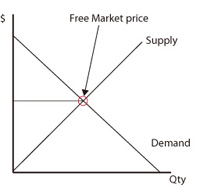
Furthermore, suppliers of a product produce more as the price goes up, and less if the price goes down. This means an upward sloping supply curve. The intersection of these two curves is the market price.

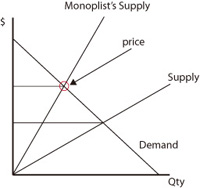
In a market where supply is controlled by a monopolist, however, the supply curve is comparatively steeper—meaning the price at which a product is sold in the market is higher, but the quantity sold is lower.

The monopolist does this simply because it wishes to maximize its profits. For those interested in a brief discussion of that math and economics involved, please see the addendum.


Monopolies Are Evil – The Evidence

Monopolies are considered evil because they cause a net loss to a society's welfare or wealth, which is called "dead weight loss"(see graph 2).

Graph 2
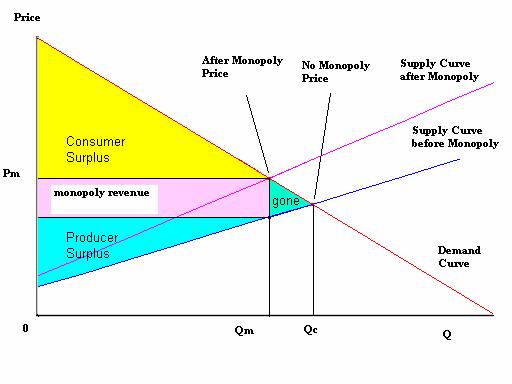

Deadweight loss is the inefficiency caused by, for example, monopoly pricing. By causing a difference between the pre-monopoly price received by a monopoly firm and the post-monopoly price paid by consumers, the monopoly firm secures a profit, or "surplus", represented by the pink area labeled monopoly revenue. This revenue comes at the expense of the consumer surplus (in yellow) and producer surplus (in blue) that would have existed in the free market equilibrium. The blue "gone" triangle of deadweight loss goes to no one because the monopoly pricing has prevented those transactions. This loss represents the inefficiency and vice of patent monopolies claimed by anti-patent advocates.

But… Not All Monopolies Are Not Evil

In economics, a more benign denotation for "dead weight loss" exists: Rent.

Whereas the term "dead weight loss" suggests that monopoly pricing results in overall waste, the term "rent" suggests that society is somehow subsidizing the monopoly's existence. These terms have undoubtedly caused much contention in economic studies. But which one is more accurate for a patent monopoly?

The following is the profit maximization formula for a monopolist:


TR(Q) is the monopolist's total revenue and TC(Q) is the total cost. π(Q) represents the profit level of a monopoly producer when the production quantity reaches Q.

If for any reason the profit function π(Q) is (or is predicted to be) 0, the production quantity Q of a monopoly will be zero. No rationale producer would be willing to continue any production activity without profit. And as strange as it seems, some situations do exist in which without any government subsidies or "rents", producers would not produce anything—even if buyers do exist.

Imagine a subway system. Would any business be willing to build an extensive system that, once completed, could be utilized by any other company without fees? Furthermore, would any company build that subway system if the population of that city were only 1000 people? The issue is in fixed costs and market uncertainty—two areas for which patents and their potential are notoriously unreliable.

Patents Are Monopolies that Need Special Care

Each year, inventors and organizations spend billions of dollars to develop and file their inventions as patents. Each year, some of these inventions go on to revolutionize (or create) markets, even changing the way societies run. But only some. The rest of these ideas, even if they become patents, sit stacked and unused, representing billion of dollars wasted and countless producers run out of business. The reasons why ideas and patents go unused vary, but regardless of the exact reason, the result is simple: despite a potential market existing and potential gain available for capture, the producer sees no potential for profit and therefore does not produce.

Fortunately, the potential of ideas are so strong, governments have implemented policies, subsidies and many more methods to encourage their continual generation and commercialization. Patents are simply one of these methods. And, therefore, in this light, we can see that some monopolies, such as patents, do require these "rents". The utility, innovation, and novelty offered by a successful patent can potentially bring huge benefit to society. And these benefits justify paying "rent" to a patent owner for its monopolistic existence.

So are patent monopolies evil? With this basic understanding of economics and the nature of market monopolies, we can easily see that "evil patent monopoly" is an overstatement.

Conclusion

Patents do demonstrate some characteristics of a monopoly, specifically: exclusive ownership as a sole provider of a technology through legal privilege and command of supply. The key point, however, is that a patent, which is a government-granted monopoly, differs from a market monopoly, government monopoly, state monopoly or government-sponsored cartels. Unlike a general monopoly with unlimited life span, a patent may easily become outdated before even making the owner any profit. This may be due to the pace of the technological development. It may be due to the official granted time limit. But to ensure that an idea can spread its benefits to others, governments have instituted systems that have created what we now know as Patents. Which are definitely not evil. Just misunderstood.

Addendum:

Profit Maximization for a Monopoly – The Math

Any supplier must be aware of two things: Marginal cost (MC), which signifies the increase increment in total cost by producing one more unit; and marginal revenue (MR), the incremental increase in total revenue by producing and selling one more unit.

A rational supplier therefore attempts to maximize its profits by producing at the point where its marginal cost is equal to its marginal revenue (MC = MR). A monopolist is no exception.

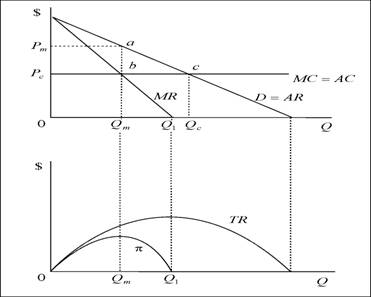
There is a single seller in a monopoly. A monopolist can affect the price and quantity of goods to maximize its profit unlike a price taker whose marginal revenue (MRm) is given by the competitive market price (see graph 1).

Graph 1: monopoly market
7

In a market monopoly, though, the scenario is a lower quantity (Qm) of goods sold at a higher price (Pm). The slope of a monopolist's marginal revenue curve (MR) is twice the slope of the market demand curve, compared to the competitive market situation (quantity Qc at price Pc). Consumers have to pay more for the same good, and there are less available. Under this market structure, a monopolistic producer therefore gains profits that a competitive producer could not.

In economics, the total revenue and the total cost of a monopoly are expressed by functions TR(Q)and TC(Q), respectively. π(Q) represents the profit level of a monopoly producer when the production quantity reaches Q. The profit maximization of a monopoly can be shown as follows.

--------------eq. 1

The necessary (but not sufficient) condition for the profit maximization of a monopoly is:

-----------eq. 2

Furthermore the production quantity of a monopoly for profit maximization is greater than zero: > 0

and are the marginal revenue marginal cost of a monopoly respectively.


Read more...


By Werner Chiu, NAIP Patent Research & Jeffrey Chang, NAIP Editorial

Since ECFA and the cross-strait IPR agreement were signed in September, many have wondered when the goals and frameworks established would become reality. But since many political, administrative and even logistical issues had yet to discussed, many were surprised when only two short months later on 11 November 2010, when China's State Intellectual Property Office of China (SIPO) and Taiwan's Intellectual Property Office (TIPO) announced the implementation of mutual priority rights recognition for patents and trademarks.


The announcement formally went into effect on 22 November 2010 and applicants may now file invention, utility model or design patents and trademarks at SIPO, claiming priority from a TIPO application, and vice versa. Priority can be claimed from applications filed on or after September 12th, the date the IPR agreement was signed.

Previous Regulations
Prior to the announcement, neither TIPO nor SIPO accepted applications claiming priority from the other office. TIPO regulations were:

If the applicant is a national of the People's Republic of China, no matter which country the claimed application is filed in, priority claims not be processed.

If the claimed application is an application at SIPO, no matter the nationality of the application, priority claims will not be processed. The only exception would be if the application is a PCT application that originated from China.

These two regulations have now been cancelled.

SIPO's regulations were similar. If a claimed application was a TIPO application, no matter the nationality of the applicant, the priority claim would be rejected. The regulation was amended on 19 November 2010 to allow Taiwan applications, albeit with limitations in application procedure and format.

Dates & Time Limits
Applications filed at TIPO and SIPO on or after 22 November 2010 are eligible to claim priority on applications filed on or after 12 September 2010.

Time limits for priority claims are the same as those set in the Paris Convention: twelve months for patents and utility models, and six months for industrial designs and trademarks.

Deadlines to submit relevant documents (i.e. copies of application): 3 months for SIPO applications; 4 months for TIPO

Fees
Priority Claim Fee: SIPO – 80RMB fee. Failure to submit the complete amount will be construed as no claim

TIPO – No additional fee

Special Regulations
In addition to some procedural and regulatory differences, due to the complex political situation, SIPO has specifically introduced rules with regards to applications.

Assignment of Priority Rights
SIPO – A single or multiple priority claims can be relinquished. However, all applicants must consent via a signed or stamped statement.

Restoration of Lost Priority Claims
SIPO – Lost priority claims may be recovered if: 1) Loss was due to failure to submit requested materials within specified time limit. 2) At least one item is filled correctly in the declaration claiming priority, however a copy of the TIPO application, evidence of transfer of priority claims rights or relevant statement have not been provided within the prescribed time limit. 3) At least one item is filled correctly in the declaration claiming priority, however, the fee was not paid or not paid in full within the prescribed time limit. 4) A divisional application's original application has claimed priority of a TIPO application.

Conflicting Phrases/Words
SIPO - If any phrases, words deemed contrary to any laws or regulations (i.e. Republic of China, the Country of Taiwan, etc….) appear in the application, SIPO will request the applicant make amendments. If satisfactory amendments are not made within 2 months, the application will be rejected! If the phrases are deemed not relevant to the technical aspects of the application, SIPO may delete words of phrases of its own accord and is not required to notify the applicant.

Non-disclosure of Address
SIPO - An applicant may choose to not publicly disclose his address and instead list "China, Taiwan".

Benefits & Conclusion
Implementation of mutual priority rights now provides applicants with more time and leeway in deciding when to file and can reduce risk of rejection. Previously, when filing for applications at SIPO and TIPO, an applicant would have to apply to both offices simultaneously to ensure an application would not be rejected due to prior art claims. However this involved the risk that the applicant would be in contravention of China Patent Law Article 20 regarding confidentiality examinations. These issues existed in addition to increased costs.

After implementation, applicants can now first file in China and request a confidentiality examination, and then after approval of confidentiality examination, file in Taiwan claiming priority of the SIPO application.


Read more...


by Jeffrey Chang, NAIP Editorial

On 29 July 2010, amid much political support, political protest and media frenzy over the signing of the Economic Cooperation Framework Agreement, Taiwan and China officials also quietly signed the "Cross-Strait Agreement on Intellectual Property Rights Protection and Cooperation" (IPR Agreement). Over the past decade, as economic relations between Taiwan and China have increased, intellectual property (IP) has gained in prominence in both business and political discussions. Both sides have long spoken of addressing shortcomings in IP collaboration and the signing of the IPR Agreement sets important goals that both wish to accomplish. However, even a general guideline on how to proceed has yet to be produced and much remains to be discussed and determined.

Two Markets, Two Systems

Since the Nationalist party fled to Taiwan in 1949, IP has remained one of the many complicated and unresolved issues. Both Taiwan and China implement their own IP systems. Both administer their own patents. Both are important participants in the global IP industry. However, neither acknowledges the validity of each other's patents. This means a Taiwan patent cannot be enforced in China—and vice versa. Most significantly, priority rights are not recognized. Copyrights, trademarks and plant variety rights also face similar issues, with added complications including copyright authentication and interpretation over well-known places names or well-known brands.

A Framework Agreement

The IPR agreement has been touted as a "framework" for future collaboration between Taiwan and China. The purpose, goals, benefits and subjects covered in the agreement can be found in the TIPO press release here. Briefly, the agreement aims for:

  1. Mutual recognition of priority rights for patents, trademarks and plant varieties.
  2. Establishment of mechanism to combat illegal IPR activities.
  3. Establishment of a formal communication platform.
  4. Copyright authentication service based in Taiwan (currently being done in HK).
  5. Search and examination results-sharing

Overall, the agreement touches upon a broad and wide range of IP areas from improving protection to increasing opportunities for economic development. In addition, many goals—such as copyright, trademark or even patent "squatting"—were written directly to address concerns of IP holders in Taiwan. Both sides have planned ambitiously, which is in line with the current Taiwan government's view that China is an integral part of Taiwan's economic future.

Collecting Public Opinion

After signing of the IPR agreement, the Taiwan Intellectual Property Office (TIPO), together with the Chinese National Federation of Industries, hosted a symposium to hear the thoughts, opinions and suggestions of the Taiwan Public. The two-day event, from 14-15 of July, was split into four discussions, covering:

  1. Trademark & Geographic Indicators
  2. Copyrights
  3. Patents, Technology Transfers & Trade Secrets
  4. Prevention of Piracy and Counterfeiting

At each event key members of both TIPO and China's State Intellectual Property Office (SIPO) were on hand to briefly explain the IPR agreement and listen to participants' opinions, suggestions and concerns. Although no decisions were made on how to proceed with the goals stated, the discussions provided an excellent window into the attitudes, frustrations and expectations of Taiwanese organizations dealing with IP in China. Many shared stories about difficulties encountered with applying for IP rights, enforcement, and dealing with the substantial experience gap between two patent offices. Overall, the symposium was a valuable source of experience sharing and learning about the successes and failures in dealing with IP in China.

First Steps on a Long Journey

Although much remains to be done, Taiwan has already begun with minor, but significant adjustments to its IP laws. On 17 October 2010, amendments to Patent Law (Article 27 and 28), Trademark Law (Article 4), and Plant Variety Act (Article 17) were passed that would allow recognition of China patent priority rights. Previously the wording of the laws required the applicant supply documents and proof issued from a reciprocating "country". To circumvent the political mutual non-recognition issue, the wording was changed to allow documents and proof issued from "a member of the World Trade Organization".

The next steps, unfortunately, will not be so easily taken. Beyond a general working guideline and schedule, the goals must be reviewed with more specific details in mind—for example, transitional arrangements, cooperation or conflicts with international standards, litigation procedures and many, many more. These topics must be discussed and agreed upon by both sides as well, ensuring that the journey ahead is not just a long one, but also one that is full of complications.


Read more...

Novelty Grace Periods in Taiwan


by Jason Wang, NAIP Patent Engineering Research

In Taiwan, a patentable invention must satisfy three conditions: utility, novelty, and inventive step. Generally speaking, if an invention is known to the public before filing, it loses its novelty. However, under certain conditions, if the disclosure was made by the applicant, he can claim a "novelty grace period" in which the invention is still considered novel and patentable.


A novelty grace period is the allowable time from the disclosure date of the invention to the filing date. It's a special rule that, under a certain conditions, prevents the disclosure of an invention prior to the application to be recognized as prior art during examination. Many people assume the grace period is for the benefit of the inventor, allowing him to disclose his/her invention before filing an application. However, reality is opposite, because of the high risk of losing "novelty" in most or even all the patent offices if something unexpected happens during the period of the disclosure to application. Therefore, to help fully explain the details, here we will explain the grace period rules in TIPO and the risks that an applicant faces.

In the Taiwan Patent Act, Article 22, paragraph 2 deals with grace periods, and states:

an invention may not be patentable if it has been published, put to public use, or known to the public before applying for patent, unless it is filed within 6 months from the date of occurrence of the following causes:

  1. Where the invention is disclosed as a result of research or experiment;
  2. Where the invention has been exhibited at an exhibition sponsored or approved by the government; or
  3. Where the invention has been disclosed in an occasion not intended by the patent applicant.

Of the three causes, subparagraphs 2 and 3 are well-defined (though proving accidental disclosure is another matter), so here we focus on the first condition, paragraph 1.

TIPO's patent examination guidelines goes into further detail about this condition:

If the content of the invention sought to be patented has been published, put to public use, or known to the public prior because of the purpose of research or experiment, for example, the publication of a thesis, the novelty of the invention is kept if the patent is filed within 6 months from the date of occurrence, which is the date that the content of the invention is available in public, not necessarily read or known."

From the example provided in the examination guidelines, we have a rough idea that something like thesis disclosures satisfies the condition set under Article 22, paragraph 2, subparagraph 1.

Most recently on 11 December 2009, a draft amendment of the Patent Act passed to the Legislative Yuan for examination, and may take effect in the near future. In Article 22, "research" was removed from the "disclosed as a result of research or experiment" (subparagraph 1) and a second paragraph, "disclosed via printed publication", was added. According to the explanation from TIPO, "research" is something incomplete and requiring further discussion or study. An incomplete invention is not a subject matter of a patent. Therefore, "research" should not be included in consideration. The phrase "disclosure via printed publication", provides a wider range of the conditions acceptable for grace period status.

In the previous paragraphs we defined grace period and described the acceptable conditions under TIPO's Patent Act. However, one important fact must be mentioned: unlike in the United States, a grace period does NOT determine the priority date of the patent. Although TIPO accepts the patent applications that disclosed prior to filing and meet conditions set in Article 22, paragraph 2, there are 3 major problems/risks caused by this process:

(1) If the applicant claims the benefit of a grace period under Article 22, paragraph 2, subparagraph 1, the invention may lose patentability in some patent offices. For example, China's State Intellectual Property Office (SIPO) allows the grace period only if the disclosure is in a national or an officially-recognized international exhibition, or in a national-level scientific seminar. In the Japan Patent Office (JPO), although a similar grace period clause exists, the recognition of "disclosed as a result of experiment" is different from TIPO. So the risk of losing patentability in other countries/regions is a major concern.

(2) If the applicant claims the benefit of grace period under Article 22, paragraph 2, subparagraph 2, the "exhibition" in which the invention was disclosed plays a key factor in its patentability. Unfortunately, currently no set definition of "officially recognized international exhibitions" exists. But for example, at the EPO, only the World Expo has been listed as a qualified event for 2010. Therefore, while you can still file a Taiwan patent after an invention exhibited in CeBIT or COMPUTEX, it has already lost its "novelty" for a European patent at the moment of exhibition.

(3) There is still a risk of non-patentability even if the invention is disclosed under the qualified conditions of Article 22, paragraph 2, subparagraphs 1 and 2. If another inventor files a patent or discloses his own invention (with subject matter which can be used as prior art against your invention), during the time between your disclosure and your application, that creates a "lose-lose" situation. The other inventor cannot receive a patent because your disclosure has made his invention "non-novel". Also under the "first to file" system, his application or disclosure also invalidated your application because the grace period only allows a prior art exception of your own disclosure. No one is able to receive a patent in this situation—unless you or he can prove that the other achieved the invention by through illegal means.

Let's take an example to explain the problem an applicant may have, if he/she does not completely understand the differences between grace period and priority. Assume that Jenny is the inventor of a special controller for the PlayStation 3. She disclosed the controller and how it works at the E3 game show, on 16 June, 2008. She filed her invention on 1 February 2009--within the 1-year grace period offered by the USPTO. On 16 February 2009, Jenny decides to authorize her good friend Huang to produce this controller in Taiwan, so she requests a patent firm to file a Taiwan patent and claim the priority from the US patent. Do you see the problem here? Although the first filing date of the invention was only half a month before her decision to file a Taiwan patent (which satisfies the regulation for the international priority claiming) 7 months have passed since disclosure of the invention to the date of decision to file a Taiwan patent. The application has no chance to meet the requirements for the grace period in Taiwan. In this case, the controller may not be patentable in all patent offices except the USPTO.

To summarize, a novelty grace period is a remedial measure for filing a patent if you have already disclosed your invention. But is an option nonetheless. However, please don't assume that this rule erases any and all disclosure, because in many countries the invention may still lose novelty. The best way to secure the novelty of your invention is still to first file the patent. Then you can claim priority of the first filing date of when applying in other countries. Just ask yourself before disclosing an invention: "Is it worth the risk of losing this patent?" I believe you will know what to do next.


Read more...


by Daniel Gross, NAIP Patent Engineer

In the almost anticlimactic wake of the Supreme Court's decision on the Bilski vs Kappos case, there seems to be little general consensus in the IP community as to what is patentable. One camp happily believes that by throwing out the machine-or-transformation (MOT) test as being definitive, the Court has further embraced the apparent 1952 Congressional intent of patentability of "anything under the sun that is made by man". Another camp views the results differently, thinking that the Court was actually contracting current scope of the statute and in fact merely added that it is not inconceivable for some future innovation to fail the MOT test and still be patentable. The Court, unfortunately, gave no examples of such an invention.

With this kind of legal ambiguity over what is patentable, many IP attorneys are gleefully lining their pockets, while, in an age of multi-multi-million dollar infringement lawsuits, the industries are scrambling to fortify against that suddenly-larger expense in product development and ownership known as uncertainty. Without such a clear example of what is patentable, even the USPTO appears hesitant to stray far from the MOT test, but I think they may be missing the Court's ultimate point. The way I interpret the decision, things might be a mess right now, but the writing is on the wall. The Supreme Court is carefully but surely slamming the door on the patentability of most software and business method patents as we know them by suggesting that they always have been, and still should be rejected as abstract ideas. Having no definitive MOT test just makes rejecting these "inventions" much easier.

In the Bilski decision, the Court threw out another bright-line test only to widen the concept of abstract ideas. With Bilski being the first, the Court also gave us a second example of the widened concept shortly afterwards when they vacated the Federal Circuit Court's decision in another patent case. The Lower Court had ruled in Prometheus Laboratories, Inc. v. Mayo Collaborative Services (Fed. Cir. 2010) that the claimed medical procedure was statutory because a drug induced modification of a patient's blood chemistry met the transformation fork of the MOT test. However, the Supreme Court directed the Lower Court to reconsider the case in light of the Bilski decision, suggesting that even meeting the MOT test is not enough to make a method statutory.

Most software and business method patents seen today would have been considered unstatutory material before the Federal Circuit's 1998 State Street decision, the case usually considered as opening the door for business method patents. Although ruled narrowly on the facts, the Bilski decision specifically singled out this same State Street decision as not being endorsed. "Nothing in today's opinion should be read as endorsing the Federal Circuit's past interpretations of §101. See, e.g., State Street, 49 F. 3d, at 1373."

Thus while many believe that the Justices were giving their de facto blessing to business method and software patents, the Court was actually doing exactly the reverse, implying that they were abstract ideas. Before Bilski, if a method passed the MOT test, it was automatically statutory material. After Bilski, this no longer proves to be the case. Why is a paper copy of software code not patentable, yet running the exact same software code on a computer suddenly turn an old machine into a new patentable machine? The Justices are asking the same kind of questions. Similarly, business methods can also be viewed as simply algorithms that use old machines, such as computers, phones, or websites to pass the MOT test, but still be abstract ideas at their core.

At the end of the decision, the opinion also included this line:
"In disapproving an exclusive machine-or-transformation test, this Court by no means desires to preclude the Federal Circuit's development of other limiting criteria that further the Patent Act's purposes and are not inconsistent with its text.”
This is spoken by a Court that wishes to contract rather than expand the scope of §101.

In response to the prodding by the Supreme Court in this decision, the Lower Court may take a different approach to developing the requested "limiting criteria" for patent eligibility. Perhaps instead of tackling the difficult job of defining what is patentable without running afoul of the law, it would be easier for the Lower Court to use what has already been long settled as statutory limits and merely define certain classes of subject material as "abstract ideas". To be sure, there would be countless court battles over whether a specific process falls into one of those classes, but there is no statutory problem with rejection of abstract ideas.

Defining classes of ideas as "abstract" could be relatively easy. For software: that which does not cause a "further technical effect" and which does not go beyond the inherent technical interactions between hardware and software. Similarly, for any process or method: that which does not cause a "further technical effect" and which does not go beyond the inherent technical interactions between the process and a machine. This basically is how Europe does it and universal symmetry of patent eligibility may go a long way toward easing some of the uncertainties of product development and ownership so prevalent today.

Unfortunately, US patent law lacks a specific "technical effect" requirement like that which is present in European patent law, so a "technical effect" requirement in the US might suffer the same fate as the MOT test (ruled as being inconsistent with the text of patent law). Nevertheless, the act of defining certain classes of ideas as abstract is not inconsistent with the Patent Act. It would merely be a generalization of historical interpretations of patentable subject matter and Supreme Court precedents such as Benson, Flook, and Diehr. In contrast, the recent push to expand patentability to software and business methods, however well intended, is in violation of the same historical precedents.

In the end, the key point is that the Supreme Court's rejection of Bilski's claims had nothing to do with the MOT test, and instead was specifically based on the rule that claims "can be rejected under the Court’s precedents on the unpatentability of abstract ideas". The Court even gave us a second example of the same rationale in the Prometheus case. The Lower Court was then basically challenged to find "limiting criteria" for patent eligibility. Again, the key point is "abstract ideas should be rejected".

While it is quite unlikely that the Congressional intent of patentability of "anything under the sun that is made by man" will be changed by this ruling, therein may be the solution. People "have" ideas, but "make" products--even digital ones. It may soon be up to applicants to prove that their software or business methods "made" something instead of being abstract ideas they "had" and then just written down or codified.


Read more...

 
Back to Top